David Dripps
I help leaders make sensible decisions about AI.
Nine years at Meta on the systems behind the internet. More than a decade building machine learning before it was a board-level topic. And a marketing agency with a 27-year operating history that I still own and run.
Most AI advice arrives from one of two directions: engineers who have never carried a P&L, or strategists who have never shipped a model. I have spent my career on both sides of that line. At Meta I worked for nine years on core technologies that power the internet, at the scale where infrastructure decisions have consequences. I have built and applied machine learning systems for more than a decade—well before the current cycle made AI a board-level topic.
I also own a seven-figure digital marketing agency with a 27-year operating history. So I sign payroll, answer to clients, and live with the operating consequences of the advice I give. When I tell you a program is worth six months of your team's attention, it is because I have run the equivalent inside my own company.
Part strategist, part technical translator, part operator—and allergic to unnecessary theater.
How I work
I start with your people
Nobody adopts a tool they do not trust. I begin with the humans who will use it: find the ones already curious, give them real problems to solve, and let their evidence do the convincing inside the company.
I explain rather than mystify
No maturity curves, no vendor theater. Plain language about what the technology does, what it costs, where it fails, and what I would do if it were my money and my payroll.
I work to make myself unnecessary
The deliverable is a capability your team owns—named internal owners, documented workflows, numbers your CFO believes. If you still need me in year two, I did the job badly.
What I actually believe about AI
AI is a genuine platform shift, on the order of the PC, the internet, and mobile. It is also not magic, and it is not the end of work. Some roles will disappear, more will be redesigned, and new categories will appear that nobody has a title for yet.
The mystery will fade too. As people come to understand the technology, it will feel less like an oracle and more like infrastructure: enormously important, increasingly ordinary. Which means the hard part was never buying the tools. It is helping people trust them, use them well, and redesign the organization around them.
What I work on
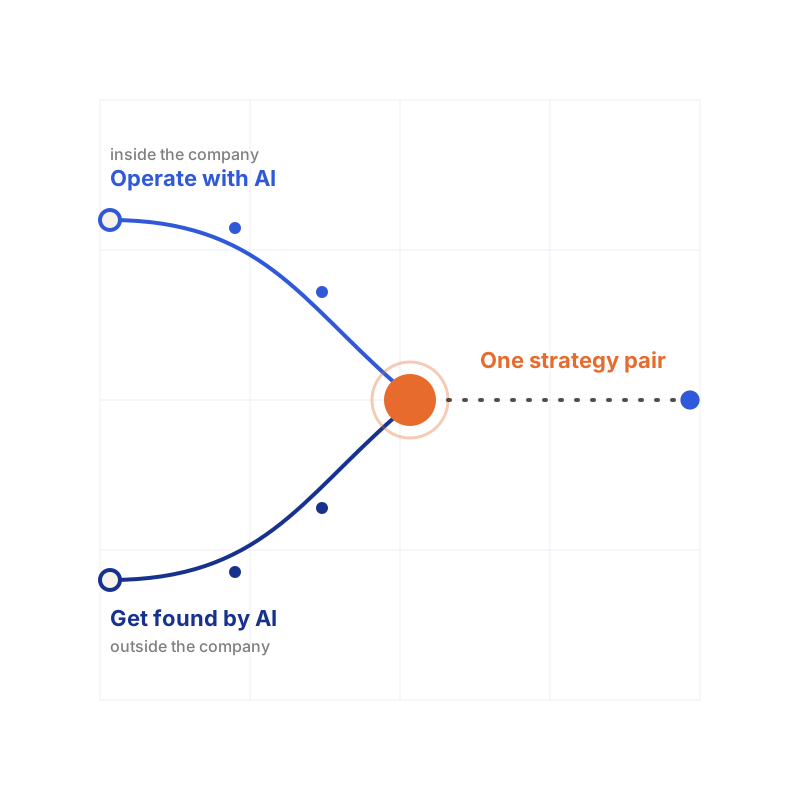
Two connected problems. Most companies need both, usually in this order.
Operating with AI
Turning AI from a scatter of tool subscriptions into a practical operating capability: real workflows, a champion cohort, executive numbers for cost and productivity, and internal owners who keep it improving after I leave.
Being found and understood by AI
Making sure search engines and generative systems can discover, understand, trust, and cite your business. AEO builds the foundation on your own site; GEO extends presence and authority across the wider information ecosystem.
Questions people ask me
What is the difference between AEO and GEO?
AEO—answer engine optimization—is the technical and content foundation: making sure AI systems can access your site, understand what you do, and find answer-ready pages that match real customer questions. GEO—generative engine optimization—is the larger system built on that foundation: presence, trust, and authority across the broader information ecosystem, so generative systems understand why they should recommend you, not just that you exist.
What does an AI transformation consultant do?
I help companies turn AI from a collection of tools into a practical operating capability: building workforce confidence, implementing real workflows with a champion cohort, creating executive dashboards for cost and productivity, and training internal owners so the capability keeps improving after the consultants leave.
Why do AI transformation programs fail?
Because they start with tools instead of people. You cannot mandate curiosity, trust, or meaningful adoption from the executive floor. Programs that skip firsthand evidence—real problems solved by trusted peers—produce shelfware and quiet resistance instead of adoption.
How do companies get found in ChatGPT?
Start by allowing OAI-SearchBot so ChatGPT search can crawl your site, then make the site technically accessible and answer-ready. Beyond your own site, generative systems weigh what the rest of the web says: consistent entity information, authoritative profiles, reviews, and credible third-party references. Inclusion can never be guaranteed—but discoverability, clarity, and authority can be built deliberately.
Book a conversation.
A 30-minute fit and framing call. No long assessment between you and the calendar—direct access is part of the offer.
Book a conversation